
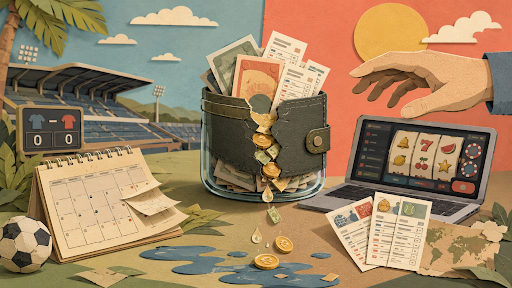
Ask a punter where their money goes and they will point to the bad calls — the nailed-on home win that wasn’t, the acca that died on the final leg. Almost nobody points to the quiet weeks when there was nothing worth betting and they bet anyway. Yet that is where a great many bankrolls actually bleed out. Not in one bad decision, but in the slow drip of the dead season: the international breaks, the summer gap, the stretches when the fixture list thins to friendlies and divisions you couldn’t find on a map.
The damage is hard to see because no single stake feels reckless. A few quid on a pre-season run-out here, a punt on a Scandinavian summer league there. It only adds up when you look at the whole month, and by then the leak has done its work.
The itch isn’t for football. It’s for action.
The first mistake is believing the urge has anything to do with football. It doesn’t. It is about action — the need to have something riding, something to check, a reason to refresh the score. When the good fixtures disappear, the disciplined move is usually to do nothing, and doing nothing is precisely what the human brain is worst at.
There is a neat piece of evidence for this from inside the game. When researchers studied hundreds of penalty kicks and the keepers facing them, they found that the goalkeeper’s best statistical option is often to stay in the centre of the goal — and that keepers almost never do it. They dive, left or right, nearly every time. The reason is not tactical. Diving and conceding simply feels less awful than standing still and conceding, so the instinct is to act even when holding position is the smarter play. A punter in a dead week is that goalkeeper. Staying flat while nothing good is on feels intolerable, so they jump — at anything.
Where the off-season money actually goes
That itch tends to land in one of two places. The first is junk football: friendlies, pre-season, obscure summer leagues where you hold less information than usual while the bookmaker keeps exactly the same edge. The second is the casino tab — slots, tables, the quick hit that fills the gap a fixture list used to occupy.
Neither is a problem in itself. The problem is doing either one by accident. If you are going to scratch the itch through the break, the only version that does not quietly wreck you is the deliberate one: a fixed sum set aside as entertainment, treated as money you expect to spend rather than grow, and played at USA online casinos real money sites that let you lock in hard deposit and loss limits before the first spin. That is a completely different activity from dipping into your betting bankroll because a Tuesday felt empty. One is a priced piece of fun with a ceiling on it. The other is the leak that does the real damage.
Stand a Chance To Win Bets Easily from Top-Notch SURE Tips >>> CLICK HERE To Get Daily Sure Football Predictions From Experts.
Junk football is a worse bet than it looks
Your edge during the season, if you have one, comes from knowing something specific the market has mispriced — a team’s form under a new manager, an injury the line hasn’t fully absorbed, a fixture that means more to one side than the other. In a July friendly, none of that exists. Managers are rotating squads, resting starters, experimenting with shape, and treating the result as the least important thing on the pitch. The outcome carries almost no signal.
But the bookmaker’s margin does not shrink to match your ignorance. You are paying the same vig you’d pay on a Champions League knockout, on what is closer to a coin flip you understand worse than usual. That is the worst trade in betting: full price for no edge. String enough of them together across a quiet summer and you have handed back a chunk of whatever the season earned you, one harmless-looking friendly at a time.
Separate the money — that’s the whole game
The single habit that protects a bankroll through the dead weeks is also the dullest: keep two pots, and never let them touch. Your betting bankroll is a working account. It has staking rules, it has records, and its only job is to be deployed when you have an edge. Your entertainment budget — if you choose to have one — is a separate, smaller pot you have already written off as the cost of being entertained.
Mix them and you corrupt both. The casino dip funded from your betting bankroll blows your staking discipline and poisons your records, so come August you genuinely cannot tell whether your season was profitable or whether the slots quietly ate the difference. Casino games, after all, are built to return less than they take — that is not a scandal, it is simply the price of admission. Priced and capped in advance, it is harmless. Mistaken for a value bet and chased, it is exactly how a disciplined bettor turns a winning year into a flat one.
Decide before you’re bored

The reason all of this is hard is that the decision has to be made cold. Nobody sets a sensible limit in the middle of a dead Tuesday with the itch fully active; that is the worst possible moment to be trusted with the question. So you make the call in advance, while the season is still on and your judgement is clean. Decide whether there is an off-season entertainment pot at all, decide how big, set the deposit and loss limits then and there, and ring-fence it from the money that does your actual betting.
Then, on the football side, practise the goalkeeper’s hardest skill: staying in the centre. The punters who last are not the ones who never touch a casino or never feel the absence of the action. They are the ones who decided ahead of time exactly how much and where — and then, when the boredom came and every instinct said dive, didn’t move.
Get today’s sure football prediction here